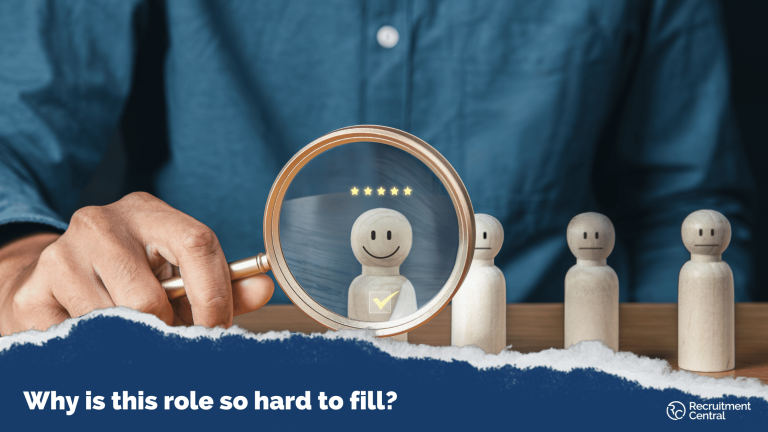
AI literacy in hiring means assessing whether candidates can use AI tools responsibly, check outputs for accuracy, protect confidential information, and apply sound judgement. For employers, it is becoming an important hiring criterion because AI is already changing how work gets done across administration, marketing, recruitment, leadership, and day-to-day operations.
AI is no longer sitting on the edge of the workplace. It is already being used to write first drafts, summarise information, analyse data, prepare reports, improve customer communication, screen candidates, automate admin, and speed up routine work.
Australian businesses are moving quickly. The Australian Bureau of Statistics reported that 12% of Australian businesses used artificial intelligence in 2024 to 2025, compared with 1% in 2021 to 2022. That is still not every business, but the direction is clear. AI is becoming part of normal work.
The investment is also growing. ABS data shows Australian businesses spent $668.3 million on AI research and development in 2023 to 2024, up from $276.3 million in 2021 to 2022.
So the recruitment question is simple:
If AI is changing how work gets done, should AI literacy now be part of your hiring criteria?
The answer is yes, but with some care.
AI literacy does not mean every candidate needs to be an AI expert. It does not mean every job ad should suddenly ask for “prompt engineering”. And it certainly does not mean hiring the person who uses the most buzzwords in an interview.
It means assessing whether a candidate can use AI tools responsibly, practically, and with judgement.
What AI Literacy Actually Means
LinkedIn’s 2025 Skills on the Rise list ranked AI literacy as the fastest-growing skill in Australia. Communication, strategic thinking, large language model proficiency, and adaptability were also in the top five. The World Economic Forum’s Future of Jobs Report 2025 points to similar themes, including AI and big data, technological literacy, analytical thinking, and lifelong learning as important workforce skills.
That combination matters. The strongest candidates are not simply people who can use AI. They are people who can use AI while still thinking clearly, communicating well, checking their work, protecting confidential information, and making sound decisions.
For most roles, AI literacy should not mean “can build AI systems”. It should mean the person can work effectively in an AI-enabled workplace. A candidate with useful AI literacy should be able to:
- Use AI tools for appropriate tasks.
- Check AI-generated work for accuracy, quality, bias, and tone.
- Understand that AI outputs can be wrong, incomplete, outdated, or misleading.
- Protect confidential company, client, and candidate information.
- Know when AI should not be used.
- Use AI to improve productivity without outsourcing their judgement.
- Learn new tools as the workplace changes.
That last point matters. The tool someone uses today may not be the tool they use in six months. Hiring for one platform alone is too narrow. Hiring for curiosity, judgement, adaptability, and responsible use is more useful.
Why This Matters in Recruitment
Many employers are already expecting staff to use AI in some way. Marketing teams are using it to draft content. Sales teams are using it to prepare outreach. Admin teams are using it to summarise documents. HR teams are using it to draft policies, job ads, and candidate communication. Managers are using it to prepare reports and meeting notes.
But many job descriptions still look like they were written before AI entered the workplace. That creates a gap.
Inside the business, leaders are saying, “We need people to work smarter with AI.” In recruitment, the selection criteria still say, “Proficient in Microsoft Office.” That is not enough anymore for many roles.
What AI Literacy Looks Like in Practice
Adding “must have AI skills” to every role is too vague. It does not tell candidates what you need. It does not help hiring managers assess capability. It may also discourage good candidates who have not had formal access to workplace AI tools but are highly capable of learning.
A better approach is to define what AI literacy means for the actual role.
In an administration role, it might mean using AI to draft documents, summarise information, and improve workflow efficiency.
Marketing roles may involve using AI for research, content planning, drafting, editing, and campaign analysis.
Recruitment roles may involve writing stronger job ads, preparing interview questions, summarising candidate notes, and improving candidate communication while protecting privacy and avoiding bias.
Leadership roles may require knowing where AI can improve productivity, where it creates risk, and how to set clear expectations for a team.
Instead of writing “Must have AI skills,” try something more specific for example:
- Ability to use AI-enabled tools responsibly to improve productivity, while checking outputs for accuracy, quality, and relevance.
- Demonstrated ability to use digital and AI tools to support research, drafting, communication, analysis, or workflow improvement.
- Sound judgement in using AI tools, including awareness of confidentiality, privacy, bias, and quality control.
This gives candidates a clearer target. It also gives hiring managers something useful to assess.
The Risk of Getting this Wrong
AI can help recruitment teams move faster, but speed is not the same as quality. A candidate who blindly trusts AI is not AI literate. They are just moving mistakes faster, and in hiring, that can mean discrimination risk and compliance exposure, not just a weak shortlist.
Regulators are catching up here too.
The Australian Human Rights Commission has published an AI and recruitment compliance checklist. The Australian Public Service Commission has also set a 1 June 2026 deadline for agencies to implement responsible AI use principles in recruitment.
The point for employers is simple: this is not only a productivity question. It is a legal and risk question too.
AI Literacy Interview Questions to Ask
Employers need better interview questions. “Do you use AI?” is too shallow. Most people will say yes. Ask questions that reveal how the person thinks, and listen for judgement, not enthusiasm.
- Tell us about a time you used AI or automation to improve the way you worked. What was the outcome?
- How do you check whether an AI-generated answer is accurate?
- How would you use AI in this role while protecting confidential information?
You are not looking for someone who says, “I use AI for everything.” You are looking for someone who can explain where AI helped, what they checked, what they changed, and what judgement they applied.
A strong answer sounds like: “I used AI to prepare a first draft, then checked the information against internal data and adjusted the tone for the audience.” Or: “I would not put confidential client or candidate information into a public AI tool.”
A weak answer sounds like: “I just ask ChatGPT everything,” or “I trust it because it’s usually right.” That’s not AI literacy. That’s over-reliance.
Employers Need to be Clear About AI Use
Candidates are already using AI to write resumes, cover letters, and interview preparation notes. That’s not automatically a problem. Using AI to improve structure or clarity isn’t very different from using spellcheck or coaching. But employers need to decide where the line is: can candidates use AI in a written assessment? Do they need to disclose it? Will you use live interviews or practical tasks to confirm actual capability?
If you don’t set expectations, candidates and hiring managers will make their own rules.
Hire for Judgement, Not Hype
AI literacy should be part of your hiring criteria when AI is part of the work. But it should be defined properly. Do not hire for hype. Do not hire for tool names alone. Do not assume the loudest AI user is the most capable one.
Hire for practical judgement, adaptability, and critical thinking, for people who can use AI to improve the work without weakening quality, fairness, privacy, or trust.
The best employees will not be the ones who use AI for everything. They will be the ones who know when AI helps, when it does not, and when a human needs to take responsibility.
If AI is changing how your team works, it should also change how you define a capable hire.
Not sure how to build this into your next role brief or interview process? This is exactly the kind of judgement-based screening we build into candidate assessment at Recruitment Central. Get in touch if you want a hand defining it for your next hire.
Ready to make hiring smoother and more strategic?
Visit our Employer Resources Hub for practical tools, proven templates and expert recruitment insights.
See how we help businesses fill critical roles quickly without cutting corners in our Hiring Fast Without Compromise case study. Stay informed with monthly updates, leadership trends and market insights, subscribe here.
For leadership resources and organisational growth advice, explore this page.